

The internet has made the world borderless. Businesses onboard customers from across the globe, financial transactions happen in real time, and digital services are accessible to almost anyone with a smartphone. This openness has driven extraordinary growth but it has also introduced a challenge that grows more complex with every passing year: how do you reliably confirm that the person behind a screen is actually who they say they are?
Identity verification has become the answer. Once a manual, paper-based process confined to bank branches and government offices, it has evolved into a sophisticated, AI-driven discipline that sits at the foundation of modern digital business. From fintech startups processing thousands of sign-ups daily to healthcare platforms managing sensitive patient records, the ability to verify identity with speed and accuracy is no longer a competitive advantage; it is a baseline requirement.
This article explores what identity verification is, why it has become so critical, how the underlying technology works, and what businesses across sectors need to understand as adoption continues to accelerate.
Defining Identity Verification: More Than a Document Check
At its core, identity verification, commonly abbreviated as IDV, is the process of confirming that a person’s claimed identity is genuine and belongs to them. In a traditional setting, this was straightforward: a bank teller inspects a passport, compares the photograph, and checks the expiry date. The interaction is human, physical, and relatively slow.
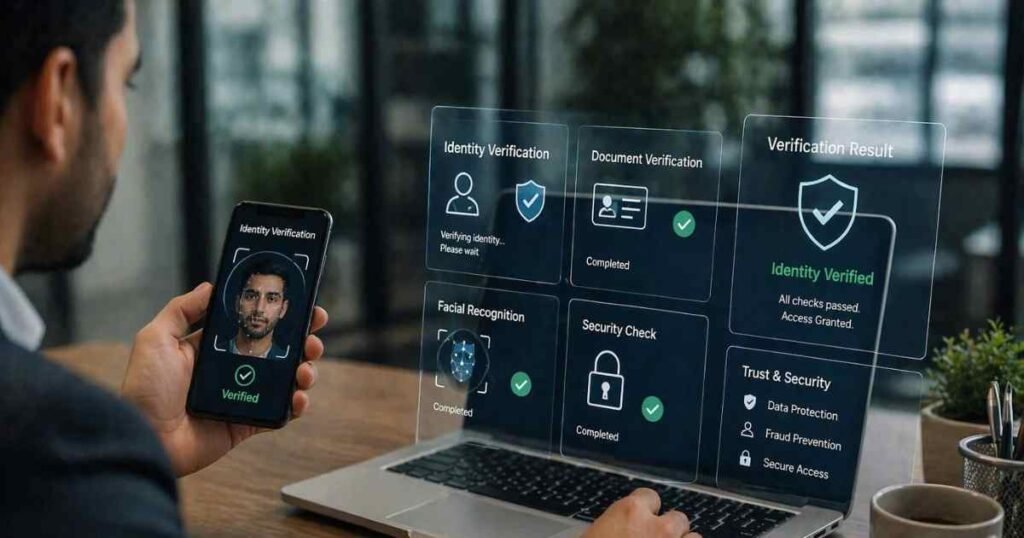
Digital identity verification replicates and significantly improves upon this process for the online environment. A modern identity verification platform combines multiple layers of analysis that go far beyond what any human inspector could achieve at scale. Document authenticity checks, facial biometrics, liveness detection, and cross-referencing with authoritative data sources are applied in sequence, typically within 60 to 90 seconds, to produce a confident, auditable result.
What makes modern IDV different from its predecessors is the use of machine learning and artificial intelligence to detect patterns, anomalies, and forgeries that would be invisible to the naked eye. A sophisticated identity verification solution does not just read a document; it analyses the font kerning for inconsistencies, verifies the microprinting, checks the document’s chip data where applicable, and maps the structural layout against thousands of known templates from countries worldwide.
The Scale of the Problem: Why IDV Has Never Mattered More
Understanding the urgency of identity verification requires considering the scale of identity fraud globally. According to multiple industry reports, identity fraud has surged dramatically in recent years, driven by the proliferation of data breaches, social engineering attacks, and the growing availability of sophisticated forgery tools accessible to non-experts.
One of the most persistent and damaging threats is the use of a fake ID, a forged or manipulated identity document presented during onboarding or verification processes. In a purely digital environment, fraudsters can submit edited photographs of documents without ever needing to physically present themselves. Older, rule-based verification systems often failed to catch these attempts, particularly when forgers replicated the overall visual appearance of a legitimate document without replicating its deeper security features.
The consequences of verification failures extend well beyond individual fraud cases. Businesses that fail to adequately verify customer identities expose themselves to regulatory sanctions, reputational damage, and financial liability. For regulated industries, the stakes are even higher: in the United Kingdom, the Financial Conduct Authority holds firms to strict standards around Know Your Customer (KYC) and anti-money laundering (AML) compliance, with enforcement actions ranging from substantial fines to the withdrawal of operating authorisation.
This regulatory pressure, combined with the commercial imperative to prevent fraud, has made digital identity verification a priority for organisations of every size and sector.
How a Modern Identity Verification Solution Works
The mechanics of a contemporary ID verification solution are layered by design. Each stage adds a dimension of confidence, and together they create a verification process that is both thorough and, from the end user’s perspective, relatively frictionless.
Stage One: Document Capture and Analysis
The process begins when a user submits an image of their identity document, most commonly a passport, national identity card, or driving licence. The identity verification software applies optical character recognition (OCR) to extract readable data from the document, and then subjects the image itself to a multi-point authenticity analysis.
This analysis checks for signs of tampering, including pixel-level editing artefacts, inconsistent lighting gradients, misaligned holograms, incorrect font weights, and structural deviations from the known template for that document type. Advanced platforms can assess hundreds of document types from countries across the world, updating their template libraries as new document versions are issued by governments.
Stage Two: Biometric Verification and Liveness Detection
Once the document passes authenticity checks, the user is prompted to submit a live selfie or complete a short video challenge. The system applies facial recognition to compare the submitted image against the photograph embedded in the identity document, calculating a confidence score for the match.
Critically, liveness detection is applied simultaneously. This technology determines whether the submitted image is genuinely live captured from a real, present person or whether a fraudster has attempted to bypass the system using a printed photograph, a digital display, or increasingly, an AI-generated deepfake. The use of deepfake technology in identity fraud has grown significantly, making advanced liveness detection a non-negotiable component of any serious identity verification platform.
Stage Three: Data Cross-Referencing
The final layer involves checking the extracted identity data against third-party databases and watchlists. This may include electoral roll data, credit reference records, sanctions lists maintained by bodies such as the United Nations, HM Treasury, or the Office of Financial Sanctions Implementation (OFSI), and Politically Exposed Person (PEP) databases.
For businesses operating under AML obligations, this stage is what transforms IDV from a simple document check into a comprehensive compliance function. It creates a verified, auditable record of due diligence that can withstand regulatory scrutiny.
The Role of the Identity Verification API in Business Integration
For technology teams building customer-facing applications, the question of how to implement verification is as important as which checks to apply. The Identity Verification API has become the standard mechanism through which businesses embed IDV capabilities into their existing platforms.
Rather than building verification infrastructure from scratch an undertaking that would require significant investment in document template libraries, biometric algorithms, and global data partnerships a business integrates with a third-party identity verification service via its API. This approach dramatically reduces time-to-market and ongoing maintenance burden, while giving development teams the flexibility to embed checks at any point in the customer journey: during onboarding, at the point of a high-value transaction, or when a user requests changes to sensitive account details.
Well-designed APIs in this space also support webhook notifications, meaning a business’s system can be automatically updated the moment a verification result is produced, enabling real-time onboarding decisions at scale.
Use Cases Across Industries
The applications of identity verification services are broad and continue to expand as digital transformation accelerates across sectors.
Financial Services and Fintech: Banks, digital lenders, cryptocurrency exchanges, and payment processors represent the largest category of IDV adopters. KYC compliance requirements make a robust ID verification solution mandatory, and the competitive pressure to onboard customers quickly makes the efficiency of digital verification a differentiator.
Online Gambling and Gaming: The UK Gambling Commission mandates age and identity verification for all licensed operators. Platforms must confirm that users are of legal age, not registered as self-excluded, and not operating under false identities. Digital IDV allows these checks to happen in seconds rather than days.
Healthcare and Telehealth: As prescription management, medical consultations, and health record access move online, verifying patient identity has become a patient safety issue, not just a compliance one. An incorrect or fraudulent identity could result in dangerous misdiagnosis or the improper dispensing of controlled medications.
Legal and Professional Services: Law firms, accountancy practices, and estate agents are all subject to AML due diligence requirements. Digital IDV streamlines client onboarding while maintaining the audit trail required by the Solicitors Regulation Authority and other professional bodies.
HR and Right to Work Compliance: Employers in the UK are legally required to verify the right to work of every employee before employment begins. Remote hiring has made digital identity verification a practical necessity for HR teams, replacing the previous requirement for in-person document inspection.
Regulatory Relevance: Navigating Compliance in a Complex Landscape
The regulatory environment surrounding identity verification is becoming progressively more demanding. In the UK, the Financial Conduct Authority requires authorised firms to implement proportionate, risk-based KYC processes, with enhanced due diligence applied to higher-risk customers and transactions. The Money Laundering, Terrorist Financing and Transfer of Funds Regulations 2017 set out the specific obligations firms must meet, and HMRC enforces equivalent requirements for businesses in the supervised sector that fall outside FCA scope.
Internationally, the picture is equally complex. The European Union’s 6th Anti-Money Laundering Directive (6AMLD), the Financial Action Task Force (FATF) recommendations, and the evolving frameworks around digital identity under the EU’s eIDAS regulation all shape the environment in which multinational businesses must operate. A well-chosen identity verification platform should be capable of supporting compliance across multiple jurisdictions without requiring businesses to maintain separate verification workflows for each market.
Notably, the UK government has been developing a broader digital identity framework that would enable verified identities to be reused across services and sectors. The Data (Use and Access) Act marks a significant step toward establishing certified providers and a governance framework for digital identity changes that will reshape how IDV is implemented and accepted across public and private services in the coming years.
Choosing the Right Identity Verification Services for Your Business
As the market has matured, the range of providers offering identity verification services has grown considerably. Businesses evaluating their options should consider several dimensions:
- Document coverage and accuracy: A global business needs a solution that can verify documents from a wide range of countries with a high first-attempt accuracy rate.
- Liveness and anti-spoofing capability: Given the rise of deepfake fraud, the sophistication of a provider’s liveness detection technology is increasingly important.
- Regulatory compliance support: The best platforms actively track regulatory changes and update their checks accordingly, reducing the compliance burden on internal teams.
- Developer experience: A clean, well-documented Identity Verification API with strong sandbox testing capabilities significantly reduces integration time and ongoing maintenance.
- Privacy and data handling: Any platform processing biometric data must meet strict requirements under GDPR, including clear policies on data retention and the right to erasure.
The market encompasses both large, enterprise-grade identity verification software providers and leaner, API-first solutions designed for fast-scaling digital businesses. The right choice depends on the volume of verifications required, the regulatory complexity of the business’s sector, and the technical capabilities of its internal team.
Conclusion
Identity verification has moved from the periphery of business operations to its centre. In a digital economy where fraud is sophisticated, regulations are tightening, and the cost of onboarding the wrong customer can be severe, building a reliable IDV capability is no longer a choice; it is a strategic imperative.
The technology itself has advanced to a point where speed and security are no longer in tension. A well-implemented digital identity verification process can onboard a legitimate customer in under two minutes while simultaneously catching the kind of forgery that would have fooled even an experienced human reviewer a decade ago. As artificial intelligence, biometric science, and regulatory frameworks continue to evolve in parallel, the businesses that invest in the right identity verification platform today will be the ones best positioned to scale with confidence, maintain compliance, and build the kind of lasting customer trust that cannot easily be replicated.
In a world where identity is increasingly digital, the ability to verify it accurately is one of the most valuable capabilities a modern business can possess.
Disclaimer
This article is for informational purposes only and does not constitute legal, financial, or regulatory advice. Identity verification laws, including KYC and AML requirements, vary by jurisdiction and are subject to change. Businesses should consult with qualified legal and compliance professionals before implementing any identity verification solution. The information provided here is based on publicly available sources and does not guarantee accuracy for all regulatory environments. The author and publisher assume no responsibility for any actions taken based on this content.
Uncover new ideas and perspectives — our featured content has something for everyone.